Wednesday, 4 November 2009

Helford river walk


I did this walk back on a perfect summer's day (yes, we did have one) that will stay with me for a long while...

A circular walk in Daphne du Maurier country -
by the Helford river, St Anthony Church and Gillan Creek


The Helford river has great allure for me, mostly because of Daphne du Maurier's books, which I have read avidly since a teenager. While the pirates might be absent, and the traders be long gone, if you walk carefully and keep your senses alert, I swear you can catch the rustle of a crinoline, the flash of a sword and the rattle of an anchor.

With this in mind, Mollie Dog and I set off one morning with Deb, Viv and her effervescent terrier, Titch, left Falmouth and headed to towards Mawnan Smith. In the middle of the village we bore right past the Red Lion pub, following signs to Helford Passage. This road passes Glendurgan and Trebah gardens, and when it bears round to the right we drove straight ahead signposted to the Ferryboat Inn. Towards the bottom of a steep hill was a sign to the Ferryboat Inn and car park – we turned right and parked here (£1 per day). Down the hill was Helford Passage, where the passenger ferry operates over to Helford Village and back in the summer months.

Unfortunately a stiff easterly wind was blowing, and together with a very low tide, meant the ferry couldn't run, so we had to get back in the car and follow signs to Gweek, then Mawgan and Helford. Finally we arrived at the car park at Helford Village and headed towards the sailing club, took a Public Footpath sign and turned left through the woods. The path here is rocky and can be very muddy in winter, and leads down some steps onto a road where we turned right up the hill then left with a stream on our right, past a stall with an incredible selection of glass stoppered bottles in blues, greens and browns. Taking the next left into Bosahan Woods (dogs under strict control here) we followed this narrow windy path through the trees.

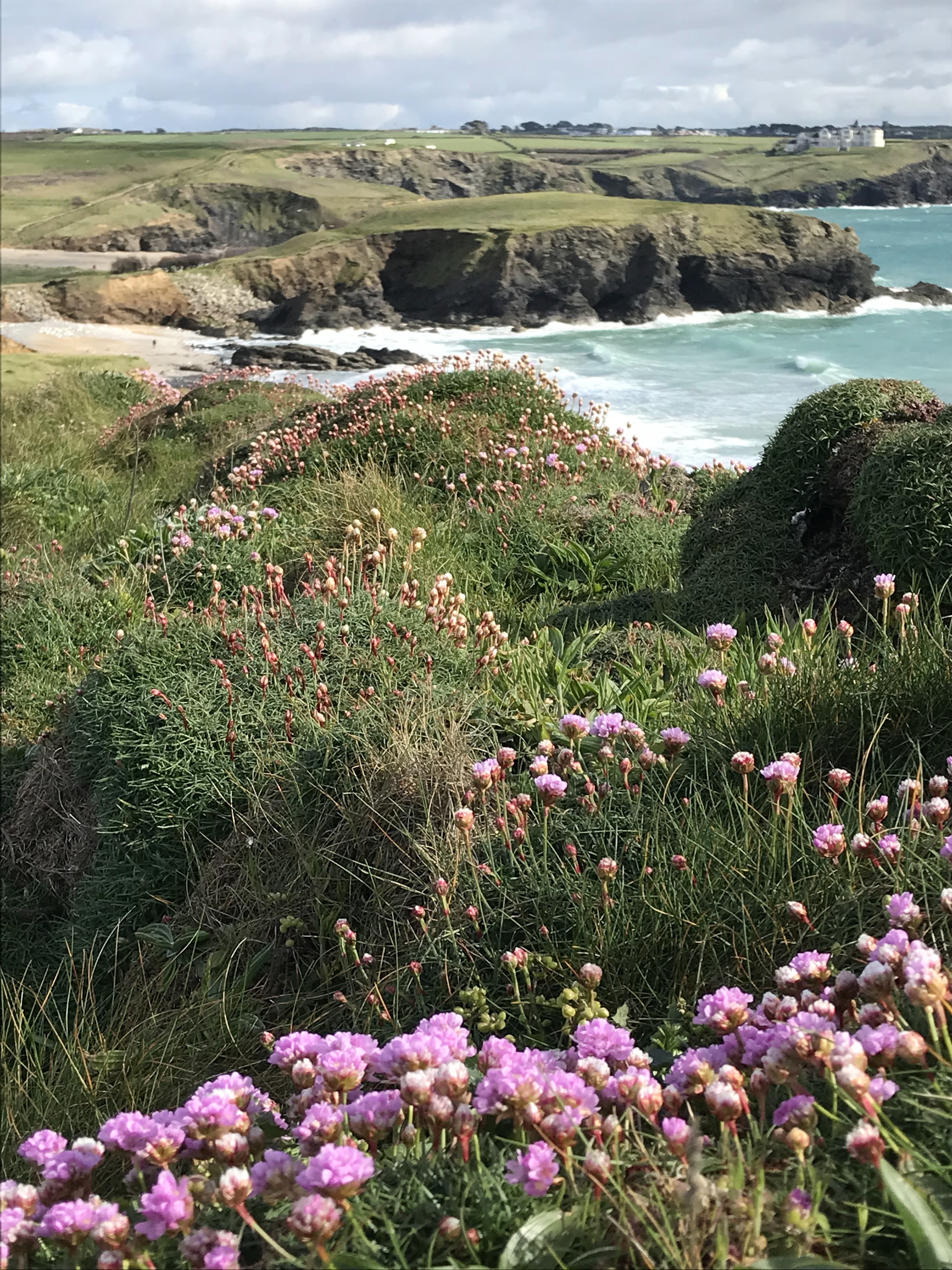
This path closely follows the shore looking over to Porth Saxon beach and Toll Point opposite. Out in Falmouth Bay we saw several tankers moored up, a couple of yachts with yellow and blue spinnakers billowing and St Anthony lighthouse in the hazy distance. Passing through a kissing gate we entered a field flanked by nettles, sorrel and clover. At this juncture we met a pack of dogs of various shapes and sizes with their owners and a friendly dog battle ensued. Thankfully canines were all rescued intact and unharmed and we continued round the edge of several fields, up a steep path, into a field at the top of the hill where the ground was scattered with speedwell and field bindweed. Looking down we could see the vastness of Gillan Creek, parched of water at low tide.

Passing through a wooden kissing gate we followed the path down the middle of this field. Knowing that I'm not keen on cattle, Deb waited till we'd got towards the end of the field before telling me that the last time she'd been here the field was full of cows and a bull, but thankfully this time there were just cowpats. This path led to a dusty track and we turned left down towards St Anthony Church.

The first mention of the church of St Anthony in Meneage is in 1170. This church, built on the bank of Gillan Creek, is said to have been built from Normandy stone by Norman sailors, as a thanksgiving for being saved from drowning. The carpeted church is beautifully kept, still lit by candles, has an old whipping post near the entrance and is well worth a visit.

Leaving the church we walked along the creek as it was low tide – otherwise take the lane bordering the creek inland for about a mile. Every Good Friday local families gather at the cockle beds at Bar Beach, Treath and Gillan to collect cockles and other shellfish. This tradition, dating from pre-Christian times, is known as trigging. People are encouraged to leave any undersized cockles (smaller than a 20p piece) and only take as many as they need for their own consumption, while still enjoying their traditional family day on the shore.

Tripping over a little spider crab, I saw a grassy knoll on our right with a wooden caravan on wheels, like a Victorian bathing machine. Incredulously we looked round, and set back in the trees was a smaller one, like a gypsy caravan, newly painted in cream and red trimming. Delighted, Mollie and I ran over to investigate and found, in amongst the bushes, several sheds and a picnic table covered by an awning. With a barbecue area out front, it was just like a scene out of Swallows and Amazons.
Leaving this area of paradise behind, we headed along the creek while a rooster crowed in the distance. Mollie scampered into what little water there was in the creek, and emerged with her tail wagging, all four legs covered in black treacly mud.
Scrambling further along the creek we came to a newly built stone wall, and just before this an almost sheer path which led back up to the lane. Hauling ourselves up, we were able to enjoy hedges full of dog roses and campion, and looking back at the creek through the trees was a bevy of swans, splashing and enjoying an afternoon siesta.
Turning sharp right inland we headed through a wooden gate (if you're under a size 10 you can squeeze past the gate post) and into woods up a long steep hill. It was stony and damp underfoot but ahead was a wall of tumbling wild roses, almost obscuring what looked like a studio in amongst the foxgloves. All we needed was the fox and we could have stepped into a Beatrix Potter book.
The path bore round to the left, past some restored barns and a sign to Manaccan. Past a churchyard on the left, we walked ahead through a lych gate and stopped in the churchyard, where an empty wooden seat awaited us, in the shade of a fig tree growing out of the church wall.
Restored by biscuits, apples and water for us and the dogs, we left the churchyard and turned right up the hill, past Manaccan Primary School. Wild sweet peas billowed out from the wall on our right and passing a cafe on the right, we took the first left signposted to Helford.
This field led over a stile, crossed the road and into another field, then downhill and into more woods. Looking up on the right was a beautiful white (grey) horse, so perfect it seemed unreal. Dazzled, we headed on through more woods ignoring waymarks to the right or left, continuing ahead where we passed a row of whitewashed cottages. Heading down a steep concreted path, this led to another row of cottages which we kept on our right, up the hill past several painters, eager to capture the beauty of Helford Village, until we arrived back in Helford car park. At the entrance is Down by the Riverside cafe, and we settled on seats outside for very welcome tea and slabs of home made cake.
As I lay awake that night, I knew that this day and this walk will remain with me forever. I relived the white sunlight sizzling the ivy leaves, the welcome easterly breeze as we rounded Dennis Head, and the silent, peaceful mystery of Gillan Creek. I can't wait to do it again.

FACTBOX
OS Explorer 103, The Lizard, Falmouth and Helston
Length: 5.5 miles
Duration: 2 ¾ hours
Grade: moderate, some steep hills; walking through the woods can be muddy and slow
Helford Passage ferry - www.helford-river-boats.co.uk.
Ferryboat Inn, Helford Passage - 01326 250625.
Shipwrights Inn, Helford Village – 01326 231235
The beach at Helford Passage is not dog friendly in summer
Down By the Riverside Cafe at Helford Village car park. There are also public toilets here.
New Inn, Manaccan

Thursday, 29 October 2009

Money can't buy me Love


I woke last night and started thinking about things that troubled me.

One was my American friend who, having lived over here for 4 years, has applied for residency. This has involved various tests, submitting both her and her partners' passports, wage slips and countless other pieces of paper and also parting with nearly a thousand quid.

She'd hoped to fly home for Thanksgiving but when she rang the Immigration lot to ask when she might know if her application had been successful, she was told to wait FOURTEEN WEEKS before ringing again. That's nearly four months in which time a) she can't go home as they have her passport, b) she won't see her mother and sister and c) she's wondering whether any day she might be deported. If she is, where would she and her partner go? And what about their beloved animals? If they had to be quarantined, she would find that so so hard.

The other thing that was my youngest brother and his family, whom we saw yesterday (see above - them off to surf). They were staying in North Cornwall for half term but he was unable to take much time off as he has a big tender coming up on Tuesday and needs to prepare for that. So no holidays on holiday.

I love my brothers to bits, but they lead such stressful lives that I thank God we don't have to live like that. Not having children helps, and the fact that neither Himself or I have ever been materialistic or acquisitive.

I was talking to a friend the other night and we discussed the sentences over the Baby P case. One of the men has had his sentence reduced and could be out of prison in three years, and the other is appealing as well. While in other cases, people are getting indefinite sentences for fraud.

Deb and I wondered - since when has money become god, meaning more than lives?

Of course money is essential for bills, mortgages, university fees, accommodation, clothing - well, we all know what it goes on. And a bit more would certainly smooth our path. Money can provide choices: a better education for children; paying bills. Holidays and clothes; boats and houses.

But it certainly can't buy peace of mind. And when you get to a certain age - I'm talking over 50 here - there might come a time when it's possible - or necessary - to rethink life. (Of course if you're happy with it anyway, there's no need.)

I realise I am extremely fortunate: I work hard and have a job I love, even if the pay isn't wonderful. Himself has very little work, but we scrape by, and I am so glad we are able to live the way we do, where we have the time and space to appreciate life.

Thursday, 22 October 2009

Stones Bakery

I go to this bakery in Falmouth a lot. Himself buys their organic flour to make bread, and they make the best flapjack ever: full of fruit, seeds and not too sweet. Think I'll have to go down there later.... read about them here and in November's Cornwall Today.

THE IMAGINATIVE BAKERS - THAT SELL BOOKS!

Stone's Bakery in Falmouth is one of several artisan bakers emerging in Cornwall to make delicious products using high quality ingredients. Having started off two years ago from an industrial unit in Penryn and a stall on Falmouth Moor they have taken over a shop in the High Street and are selling out with their delicious baguettes, focaccia and sourdoughs, as well as speciality breads including garlic and thyme, and a spelt and honey loaf. They also sell a wide range of cakes, croissants and cheese straws and are renowned for their flapjack. And to cater for all tastes, they even sell books!

Oliver Kingdon, 29 and his wife Rosie, 28, seem a quiet, industrious couple but their faces light up when they start talking about their food. “We get our organic flour from three places – every mill produces a slightly different type of flour that suits different types of bread,” Oliver explains. “Stoates & Son are a Dorset firm that provide good wholemeal spelt and rye flour.”

“We did look into getting Cornish flour but there wasn't anyone who sold it on a large enough scale,” adds Rosie. “So we get white flour from Shipton Mill, and self-raising and plain flour for cakes from Doves. We tried them all out to see what suits which bread, and we've tried to go with smaller independent mills - they're more knowledgeable and specialised.”

“Organic flour has less pesticides, as wheat is a crop that is heavily sprayed,” Oliver continues. “The flavour from stoneground is better and they blend different types of wheat which have different levels of protein.”

“We wanted the flour to be organic because it tastes better,” says Rosie. “We're not completely organic because we wanted to keep our prices down but the flour is. And in some areas you don't necessarily taste the difference. We wanted to make our products at a price everyone could afford.”

The shop is open from Tuesday to Saturday from 9-4 but the hours are flexible. “There are always things to finish up at the back so if we're there we might as well sell things,” says Oliver. “We're happy for people to tap on the window!”

Oliver and Rosie Kingdon met at Hull university 9 years ago and have been together ever since. After leaving university, Oliver got a job at a small organic mill and bakery at Lincolnshire. “I'd always been interested in food, and I wanted to do something practical,” he explained. “I also did a Panary course which is like bakery school.”

“We liked the idea of being self employed and we both enjoy baking,” Rosie says. “It seemed something we could do on our own so we went from there.”

The couple moved to Cornwall two years ago. “We'd been here on holiday and wanted to live by the sea,” Rosie says. Initially they lived in St Ives, and named the bakery after the notorious Stones Reef off Godrevy Island. They found the industrial unit in Penryn, and set up the stall in Falmouth. “We liked Falmouth as a town,” says Oliver. “It's a year round town not just tourists, which is good for business.”

“We didn't want to take on a huge amount of risk so the stall allowed us to start off small and test the water,” explains Rosie. “If it hadn't worked, we would have done something else. In fact we built up a customer base but if it was really windy then the market would be cancelled and we couldn't trade that week. So we wanted something where we could be there 5 days a week, year round.”

This job is not for the fainthearted - Oliver starts baking between 3 and 5 in the morning, five days a week. “When we had the unit I slept in the day and never saw anyone,” he says. “I'm used to being covered in flour!” he adds with a grin. “But with the shop we get to know our customers and see more of each other.”

Rosie makes the cakes in the daytime in between serving customers. “There aren't many places where you can buy a cake which is just made out of the ingredients you'd have in the fridge,” she says. “If we have fat in the cake then it will be Trewithen butter, and eggs from Cornhill.”
“If there's chocolate then it's proper chocolate melted by us, not chocolate flavour,” adds Oliver. “We experiment a lot with the cakes but if they don't sell, we don't make them.”

The most popular items are baguettes, chocolate brownies and the longest cheese straws ever seen. “We use Trewithen butter in the croissants and cheese straws, and you can really taste the creamy flavour,” says Rosie. “They're made from a croissant base and we use Cornish cheese,” adds Oliver.

At the moment their favourite is a rye sourdough loaf. “We make it just for Saturday in an Eastern European style,” says Oliver. “It's a really moist, dark sticky loaf that looks like a little brick!”

They've found the other shop owners in the High Street very friendly. “Lots of them pop in to pick things up and the hairdresser is always recommending us to her customers!” says Rosie. “There's a strong sense of community along the High Street,” adds Oliver. “When we first started work on the building we got cards from some of the others saying welcome and lots popped in to say hi. It was really nice.”

This enterprising couple don't just sell their own baking and muesli. They also stock Kyfyth Kernow jams and chutneys, greetings cards by illustrator Beth Knowles, chopping boards and cutlery trays from Barncrest in Penryn who made the wooden shop counter. They even sell second hand books. “The books come from a friend who owns Beerwolf books on Falmouth market,” says Rosie. “They have a really good selection so we decided to stock them as well.”

Having their own business has been a steep learning curve but despite having proved such a success, they have no plans to change. “Some people expand too quickly and lose the quality of the product,” explains Oliver. “If we have an idea we can find out what people think of it immediately by having tasters on the counter.”

“We want to do something practical, not have to manage lots of people,” adds Rosie. “I enjoy serving the customers – if I make a tray of flapjack then a couple of hours later it's me that sells it – that's immediate satisfaction. Particularly when they come back and tell me how much they've enjoyed it!” She pauses. “The way the shop looks is just how we want it to look. It reflects us as individuals.”

Oliver and Rosie are conscious of needing a balance between work and their lives outside. “We've got to enjoy our work and our customers, but we also want to be able to enjoy the lovely place we live in,” says Rosie. And despite not wanting to expand, in one way they will, for Rosie is expecting a baby in December.

“I'll probably get more help in the shop and work part time at first,” says Rosie thoughtfully. “But we'll see what happens.” Oliver smiles at his wife and his eyes twinkle. “We'll just get the baby baking!” he says.


Stones Bakery
28a High Street
Falmouth TR11 2AD

07791003183
stonesbakery@hotmail.co.uk

Stones Bakery also attend St Ives Farmers Market on Thursdays

Friday, 16 October 2009

It's Never Too Late

Last night we had a novel writing meeting, and one of those present was Nancy. My inspiration. She is in October's Cornwall Today.

After twenty years away, a 70 year old Cornish woman returned home
and embarked on her third career.

Nancy Kinnison has a lot in common with the late Mary Wesley, who once said, ‘Sixty should be the time to start something new, not put your feet up.’ Nancy agrees with this, having changed career – again – when she retired from teaching at 65. Her latest reincarnation is perhaps one of her hardest challenges. Becoming a writer.

‘I’ve always wanted to write,’ Nancy says in her breathless fashion. ‘I had a very encouraging teacher at school, then, when I was married, I started writing short stories. I always said that when I finish work I will write, and that’s what I've done.’

Nancy talks quickly, waving her hands as she speaks. She wears no makeup, and her jewellery is all silver; a pair of dangly earrings, a variety of chunky rings on each finger, and a pendant. She is short and stocky, with understated, comfortable clothes that struggle to contain her overflowing enthusiasm. Her eyes flash back and forth, missing nothing.

‘The worst bit about being a writer is the frustration of trying to put emotions into words that will evoke those feelings for a reader,’ she says.

Nancy moved back to Cornwall in 2004 because, “simply, it's home. But I'd lived in cities for 20 years and enjoy their facilities: that's why I chose to live in Truro. It's at the centre of Cornwall but only minutes away from the sea; the sound of breaking surf was a childhood lullaby.”

What did she miss about Cornwall? She laughs. “Everything! The people – their down to earth character and wicked sense of humour. The infinite variety of its landscape, and above all, the untameable and ever-changing sea.”

Nancy now lives in a small house on a quiet estate in Truro. Her living room is filled with novels, books on psychology, Cornish magazines and newspapers. A collection of fruit ripens on the window sills, next door to pots of basil and parsley, and above the television are a collection of photographs of her grown children and grandchildren. An ordinary house, you might think. But there is nothing ordinary about Nancy.

She was born and brought up in a small fishing village in Cornwall, and started pre-nursing training in 1950 aged 16 before doing her nursing training at the Royal Devon & Exeter Hospital.

When Nancy married a policeman in 1957 she worked as a staff nurse until she had children. When they were at school she returned to work, but not for long. ‘It was impossible to fit in with my husband’s shifts while the children were young,’ she says. ‘When they were older I did my Diploma in Nursing and worked at Treliske hospital as a night sister for two years.’

In 1976 Nancy’s marriage broke up. ‘My husband left when the children were 15 and 18,’ she says, the pain and anger still clear in her voice. As a result she left nursing and worked as a technician at Falmouth School. ‘It wasn’t the most fulfilling of jobs, but it was right at the time,’ she adds resolutely.

When Nancy was 45 she applied to Southampton University to read Sociology and Social Administration. ‘I’d always wanted to go to university but never thought I was bright enough.’ She smiles defiantly. ‘I was terrified. Most people considered going to university at my age ridiculous, but I thought I must try - and fail if necessary.’

So she’d never thought about going to university earlier? ‘Coming from a working class family, it wasn’t an option,’ she said. ‘But if I could change anything about my life I would have gone to university earlier. It was the first step to finding intellectual fulfilment.’

Nancy got her degree and secured a lecturing post at North London College teaching Sociology and Psychology. ‘I got a tremendous amount out of all my various jobs,’ she says, her eyes gleaming, ‘but teaching was the most rewarding. Having piloted a BTEC Nursery Nurse course, I applied for a job to set up a similar course in Bath. I stayed there till I retired in 1997.’

Most people would have some time off before starting on another career, but not Nancy. ‘The second Saturday after I retired, I went on a writing course and started writing,’ she says with her open laugh. ‘I wish I’d started earlier – someone told me it takes ten years to produce anything professional.’

But since then Nancy’s short stories have appeared in QWF (Quality Women’s Fiction), Woman’s Own, Fiction Feast, Yours and Family Circle, which has greatly increased her confidence.

‘I've joined various groups, attended a novel writing course and started writing my first novel,’ she says. The novel, the first of a trilogy, is set in the 1950s, about a young nursing student. ‘I wanted to show how different nursing was then compared to now,’ she explains.

The novel was interrupted when an ex-colleague asked her to collaborate on a psychology textbook for nurses. ‘If I’d have known how much time it was going to take, I probably wouldn’t have done it,’ she says. ‘But it’s in print now, so I've gone back to my novel which is such a relief!’

At 75, Nancy is aware that she has less time than some of us, but this doesn’t deter her. ‘I always knew that learning how to write would be a long slow process,’ she says. Her hard work was rewarded last year when a London literary agent asked to see the whole manuscript. 'She turned it down, but to have got that far is very encouraging,' Nancy says. And she is positive about the future. ‘In five years time I hope to be writing a bestseller - my third best selling novel!’

Nancy is an inspiration to anyone regardless of sex or age. So what advice does she have? ‘If you want to try something, do it,’ she says. ‘Get tuition, join groups – take whatever you're doing seriously.’ She looks up and smiles. ‘It’s all about having the courage to try. If there’s something you really want to do, go for it.’

Sunday, 11 October 2009

The Jewel in the Crown


We're now back from holiday and there's nothing like going away on holiday to really appreciate Home.

Don't get me wrong - we had a great time. The cottage was lovely, and had a very good range cooker that Himself fell in love with, and made great use of (so we were all happy) and a back yard for Mollie so she was happy. My mum came for half the week, various friends dropped in, we had cousins for supper, and a very good pub within a few minutes walk. Perfick, as Pa Larkin would say.

The weather could have been better, but there was one day that really stood out for me. Our cousins had told me about a Bronze Age settlement called Carn Euny – from there you can walk over to Chapel Carn Brea, one of the highest spots in Cornwall. I did this walk on the one really good day we had where the sky was dark blue and I could see for miles.

Himself looked at the map and said “you just go up to Carn Euny and go left,” as if I was in the middle of a town.

I grunted, he said he'd meet me at Chapel car park, and we both departed in opposite directions, Mollie scampering behind me. Well, suffice it to say that as I'd figured, it wasn't as simple as Just Turning Left. I found Carn Euny and that was an incredible sight – but from then on it got tricky. I looked at the map but the green lines indicating Public Footpath didn't bear any resemblance to the paths in front of me. So I retraced my steps and started again.

Then I found another map which seemed to indicate I was going in roughly the right direction, so I continued. After I'd been walking for about 40 minutes (Himself had reckoned the entire walk would be 30 mins), my phone rang. “Where are you?” he said in his I'm-not-worried-just-enquiring-voice.

“I've no idea,” I said. “I figure if I don't find you I'll retrace my steps.”

Silence. “Where's the sun?”

“On my left.”

Another pause. “You should be walking into it, Pop.”

We left it that I'd continue for another ten minutes and if I was still lost then, I'd go back.

But then I came to the top of the hill and the path curved into the sun. I took a deep breath and there was Cornwall laid out before me in all her glory. Scilly glimmered in the distance, Long Ships lighthouse stood proudly in the sea before me, a small airplane took off from Lands End runway, and I took a deep breath, breathing in that exhilarating air, and realised how lucky I was to be there, at that time, with the wind whipping my hair, the sun beating down on me – and Mollie wondering if I was whooping because I'd really flipped.

Looking round, there was such a dizzying sense of height and depth and space. And here, in an area that hasn't been overly farmed, and apart from the monstrosity that is Lands End, hasn't been mucked around by tourism, it's possible to see a glimpse of the real, rough Cornwall. The land as it was in the Bronze Age. An earthy, raw feeling that is simply very, very ancient and basic and simple.

And that glimpse – that for me was the real jewel in my holiday crown.

Wednesday, 30 September 2009


Many thanks to Debs who kindly passed this "Your Blog is Fabulous!" Award which stands for: Integrity. Commitment to Excellence. Stubbornly Optimistic.

THE RULES:
List five current obsessions:

Well – I'm scratching my head here because I'm trying to send everything to my editor before I go away tomorrow, remember to pack what I need for the funeral in Devon on Friday, and also thinking about what we'll need to take with us when we go on holiday on Saturday. Oh, and because I'll be doing a couple of interviews while we're away, I need to take notebooks, walk books and tape recorder. Plus list of questions for interviewees, spare batteries for recorder – all that sort of stuff.

So these obsessions might be a little distracted. Please help yourself to this award and meme - you deserve it!

In no particular order -

1.Writing. Thinking about writing or writing does, I realise, take up a lot of my life. Not that I'm complaining, but it does. I need it in order to breathe, to function. When I'm upset or confused I write something down to make sense of it. When I'm happy I write about it. In fact, here I am now rabbiting on about it. So yes, that is definitely an obsession.

2.My family and friends – my immediate family is Himself, Bussie the cat and Mollie the dog. I love them more than I can say. And I know you're not supposed to let dogs sleep on your bed, but I do sleep so much better with that hot little body squashed against mine..... As for my friends - where would I be without you all? Thanks for everything. Darn – this is sounding more and more like an Oscar acceptance speech.

3.Cruelty to animals – don't get me started....... just light the touch paper and STAND BACK!!

4.Himself would tell you about my over-sensitivity (frequently concerning how other people are feeling) which causes a lot of agonising. I'm currently thinking of a poor friend who has just borrowed my cat box to take her cat to the vet for The Last Trip.....

5.Walks – I spend a lot of time walking with Molls. As from 1st October the dog ban is lifted so we can go on the beaches – hooray! They are always a good place to think and explore thoughts. I have learnt a lot about friends on walks – it's a good way to share concerns and sort the world out.

6.Enjoyment. I am a firm believer in enjoying the small things of life, not the expensive ones (can't afford those). A good book, flowers on my desk, a nice bottle of wine, a piece of home made flapjack, a weepy movie, sitting in the sun with Molls.

See? Life can be fun on very little money! (Just realised that's six but never mind - you have one for luck.)

I will be back in a couple of weeks – have a good time everyone. It's bound to rain now I've mentioned the H word....

Friday, 25 September 2009

Fencing

In October's issue of Cornwall Today -

LEARN TO SABRE FENCE - A GREAT WAY FOR ANYONE TO GET FIT!

I've always been attracted by fencing for its skill, elegance and drama, so when I had the chance to try it out, I jumped at it. Arriving at Truro Fencing Club I was greeted by Maxine McCombie, a diminutive figure bouncing with fitness, who started fencing 6 years ago at the age of 23. She is a TFC club coach and ranked 10th in the nation in the Sabre category. “Fencing attracts many women - it's good for improving general fitness, co-ordination and agility,” she explained.

Jon Salfield, Head Coach, joined us as we watched the Performance Programme in training. “We have 7 people training towards the 2012 Olympics and aim to offer the most comprehensive sabre training available in the UK,” he said. This gives athletes the tools to achieve world-class results, and build a pathway for future generations of international fencers. “Truro Fencing Club have already achieved great successes and hope to build on these.”
But TFC are also a very inclusive and friendly club, keen to encourage fencers of all ages and abilities. Even crocks like me!

Jon explained, “Sabre fencing is such a dynamic sport. You only have a knife edge of time in which to hit the other person so you have to be so focused. You need to concentrate 110% of the time.”

I wondered if my brain cells were up to it, but after showing me the electronic scoring device, Maxine took me to the far end of the gym to put on the kit. “Fencing is very safe because we use safety equipment which is regularly updated,” she explained, and showed me the pieces of kit that beginners wear. “A chest protector (for women), a plastron, or under-jacket for the sword arm, and a jacket which is worn over the top made of Kevlar based material.” All of this is very lightweight cotton but, apparently, made of the same technology as bullet proof vests!

Next came a white glove like a gauntlet, worn on my sword hand and lastly, but most important of all, a mask made of very strong steel with a bib to protect the neck.

First of all Maxine showed me the salute, which is an integral part of fencing. “As it's a combat sport we acknowledge respect for our opponent.” I had to point my sword down towards the floor then bring it straight out in front, then bring the guard up to my nose and back down. “You salute your opponent before and after your fight and also salute the referee and salute at sword point. It's not a violent sport: you try and outwit your opponent.”

Once kitted up, Maxine explained the three types of sword in fencing. “The sabre is used with a cutting action of what would have been a cavalry sword to hit your opponent, whereas with the other two swords, the foil and epee, you can only use the tip.” We were to use a sabre which is a relatively new competitive sport for women, starting at the Olympics in 2004.

First of all she showed me how to place my thumb and hold the sword up in the air. Next came foot work which is quite specific. “As you're right handed, put your right foot forward and always keep it straight,” said Maxine. “Then your back foot turns out to the side at a right angle giving an L shape, then you bend both knees. That's your en garde position so that when you do your lunge you have a good starting position, and your sword comes out at the front.”

She showed me how to move my front foot forwards, then the back foot, and to move backwards start with the back foot, then the front foot. All footwork is a variation on this step, using different patterns and rhythms depending on how the fight's going.

Next came the lunge; the long attacking action. “Your back foot stays flat on the floor and you push forwards into a long stretch and your front knee is bent over your ankle. To get out of it you push backwards into the en garde position. Well done!” I glowed at the praise, though having done both ballet and yoga was a help.

Just when I thought I was making progress, we moved on to attacking. “In sabre the target area is everywhere above the hip line: arms, chest, head, even the sides and back, apart from the hands,” Maxine told me. First I had to hit her on the head, then the chest with the original cutting edge of the sword, and she showed me how to put up my sword to stop a hit. “The three areas to be hit are the head, chest and flank. So you need three main defense blocks, using your sword to stop your opponent hitting you. This is called a parry.”

A parry signifies the end of an attack, then it's time for the opponent to attack. She showed me another way to stop your opponent which was easy: “Step back, out of the way.”

Having shown me the sword work, I then added the footwork, stepping backwards to avoid Maxine, then lunged to attack her. I wanted to know when you hit each other? “When you move forwards, you have the attack,” said Maxine as our swords clashed – she's a very clear and patient coach.
“As soon as you've made me miss or defended, then it's your attack and I have to defend myself, so priority is given to the attack. You can't just hit.” So that cleared that up.

“You're constantly working with the balance of attacking without getting too close,” explained Maxine. “Basically it's attack, parry and change of rhythm.”

I could see that in fencing concentration is vital, as is timing, footwork and lightning-quick reactions. Maxine nodded. “I love the competitiveness and the activity: it's adrenaline fueled but you have to keep your head working. You compete against yourself to improve and your opponent, so they push you to deliver your best fencing.”

By this time I was on an incredible high and my head was spinning: I'd never realised fencing was so complex. But Jon and Maxine are excellent ambassadors of the sport. Their enthusiasm is so contagious, you really want to have a go.


www.trurofencing.co.uk or ring Jon on 07779 130942.
info@trurofencing.co.uk

Truro Fencing Club was founded in 1970 and now has over 100 members. It costs £25 per month or £15 for children for 2 practices per week, overseen by 5-6 coaches and includes clothes and equipment. The club meets on Mondays, Tuesdays and Thursdays and new members of any standard are welcome.

FACTBOX
Fencing can be traced back to the 12th century and was one of the disciplines at the very first Olympics in 1896.

Sabre
The fastest of all the fencing weapons, and the only one which uses cutting actions as well as point attacks. The sabre is descended from the eighteenth and nineteenth century heavy cavalry sword. The target for sabre is above the waist, and simultaneous hits (within 120 milliseconds) are decided by 'right of attack'. Any contact is a valid hit at sabre, ie. no particular level of pressure is required to score a valid hit.

Epee
Heavier than the foil and with a larger guard, the epee is descended from the dueling rapier of the sixteenth and seventeenth century. Hits can be scored anywhere on the body and must be made with the point. For a hit to be valid it must be delivered with at least 750 grams of pressure (this is detected by a spring loaded tip which is wired to an electronic scoring box). Simultaneous hits score one point each.
Foil
A light weapon, developed from the small-sword of the eighteenth century. Hits are made on the torso with the point, and simultaneous hits are governed by 'right of attack'. This means that the fencer who initiates an attacking movement will score the hit, unless the defender first deflects the opponents blade, or makes it miss. For a hit to be valid it must be delivered with at least 500 grams of pressure (this is detected by a spring loaded tip which is wired to an electronic scoring box).